
On Dignity and Refusal
My paper from this last weekend's RSA conference

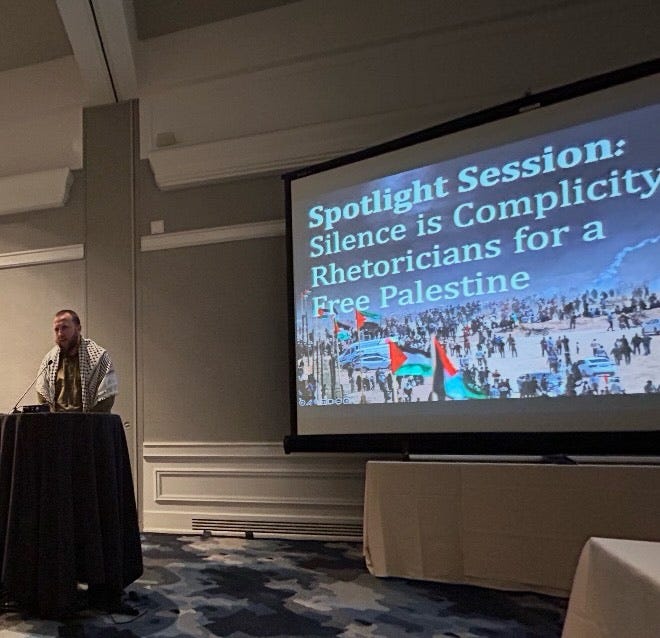
In the 2024 presidential election, me and over one thousand of my neighbors in Brooklyn wrote in Hind Rajab for president. We did this to protest the choices with which we had been presented, two political parties which supported the State of Israel’s genocide in Gaza either rhetorically or financially. Of course, in a heavily Democratic state a protest vote is of little material consequence, but the campaign did register a small response in the local media. I spent the night following election day volunteering at a town hall put on by an activist organization which featured a series of panel discussions presenting different perspectives on the election. I awoke aghast that Donald Trump would return to the White House but proud of my decision.
About a year later, me and over one million of my neighbors marched to the polls to elect New York City’s current mayor Zohran Mamdani, who I met as a volunteer at a soccer tournament he hosted to raise money for UNRWA in the early months of the genocide. I did so with pride, and I was glad to stand in line for over an hour at the polling station because turnout in my neighborhood was so high. The feeling of joy and solidarity amongst the residents of south Brooklyn on that day has, in my experience, only been matched by the jubilation at Michigan State University when Barack Obama was elected in 2008. Both of these days stand out in my memory as instances where I lived in accordance with my own values.
In both cases, my own vote was ultimately insignificant to the facts on the ground in Gaza. At most, my individual vote for Mamdani is one piece of a much larger political transformation underway as we speak today, where popular anger turns against the Trump administration and left wing populist candidates surge in polls and primaries. And yet, the vote itself is treated as so significant in public discourse. Palestine supporters like myself have been blamed for Trump’s return to the White House, much like Bernie Sanders supporters were blamed for Hillary Clinton’s loss to Trump in 2016. The data clearly indicates that we either were insignificant in the final vote totals or it was the party’s failure to attract our votes. This, however, is immaterial. It is the vote itself and the performative quality of discussing one’s vote that forms the centerpiece of the discussion.
Today, I would like to treat the gesture of abstention from the 2024 election as a generative rhetorical disposition of refusal. Refusal, that is, to sacrifice the dignity of the Palestinian people. Refusal to sacrifice the dignity of life itself in the face of our society’s complicity in Israel’s actions. One vote, or lack thereof, on an individual basis has little impact. Rhetorically it has no impact whatsoever unless one talks about it, given the sanctity of the ballot box.
Thus, debates about abstention from the 2024 presidential election are in fact debates about the proper disposition toward the idea of voting. In this exercise, I will make a strong affirmative case for the rhetorical performance of abstention from the 2024 election. As in, I will argue that abstention from the 2024 election is and was a recognition of the dignity of human life, a recognition which under the circumstances could only come as a recognition of the dignity of Palestinian life.
First, I believe that the consequences of Trump’s return to the White House must be decoupled from this gesture of refusal. Both because an individual person’s vote obviously did not decide the entire election and secondly because one person’s gesture of refusal does not cause another person’s vote. In fact, a person could outwardly reject the false choice between two parties complicit in Gaza’s annihilation and quietly vote for either candidate. The gesture of refusal has often elicited the accusation that the refuser will not be impacted by Trump’s policies, the refuser is indifferent to the impact on others, or the refuser is simply stupid and does not understand the consequences of their actions. This of course implies that this gesture of refusal belies a lack of moral character or a lack of intelligence. By this logic, a refusal to surrender the dignity of human life by way of a surrender of the dignity of Palestinian life is ostensibly motivated by moral or intellectual failings. Surely none of us would teach our students to address their fellow citizens in such a manner when discoursing on an upcoming election.
Secondly, the gesture of refusal honors the dignity of human life by way of honoring the dignity of Palestinian life. In so doing, it rejects a vision of the future which is built on the extermination of Palestinians and performs the rhetorical work of constructing an alternative future where the inclusion of Palestinians amongst the broader mass of humanity forms the beating heart of a new vision of democracy and social justice. Thus, this gesture of refusal is an egg from which a new vision of American politics can hatch and take flight.
None can deny that the rising wave of left populism sweeping across America is in large part a reaction to Trump’s return to the White House and the inability of our political elites to resist his policies or even defend our universities and professions. It has become clear from the genocide in Gaza and the subsequent atrocities in Minneapolis and elsewhere that the people themselves must take responsibility. We must take responsibility for what our society is to become. Rhetoricians in particular must take responsibility for participating in public discourse in such a way that guides others to the most ethical and effective forms of discourse, rather than merely critiquing public discourse amongst themselves.
The dignity of Palestinian life was once a secret litmus test, a way to identify safe people and spaces. A Palestinian home has been a secret refuge for many. Friendship with a Palestinian or acceptance amongst Palestinians is a secret treasure for many more as well. Respect amongst Palestinians is one of the greatest badges of honor which can be bestowed upon a human being, but for many in our society this has been a well kept secret. Before now, the dignity of refusal embodied by the Palestinian people has been a quiet one, recognized by those in the know but hidden from view. This is no longer the case. A politician’s stance on Palestine now functions as a window to their moral character. A union’s stance on Palestine signifies their dedication to democracy and social justice beyond their own immediate economic interest. None of this would be imaginable without the initial gesture of refusal which rejects any idea of a world where Palestinian life is unspeakable or forced into the shadows of history. I had to refuse in order to remain human.
The dignity of refusal, as is always the case, will extend beyond the issue of Palestine into every other area where false choices must be rejected. Across the country, universities face dual economic and political pressures. The state budget is a cudgel with which to demand that we turn against our vulnerable colleagues and students. We may be placed under soft pressure to remove LGBT topics or critical race theory from core curriculums. We may be placed under hard pressure to terminate or discipline a colleague for pushing back on transphobia. Some will excuse making the wrong choice because they don’t want to lose their careers. But really, what career do we have to lose?
Especially those of us at the beginning of our time in the professoriate, no administrator at any of our campuses would ever promise us that we will be able to keep our positions long enough to retire. They would never actually offer the carrot that previous generations received in exchange for their silence and docility. All that remains is the stick of suspension or termination. We will withstand these attacks and retaliations together or we will all live in fear for the rest of our working lives. I will not survive 40 more years if I have to spend it afraid. I will teach my students and conduct my research with dignity or not at all.
In closing, I anticipate the objection that my remarks today have little to do with rhetoric. I reply that I attended this conference two years ago during an active genocide that was not acknowledged, so I don’t know that I even care to be situated in the literature. I ask then, what is rhetoric for? Is it for us, our professional prestige, our self concept, our luncheons and keynotes, or is it something we possess with which we can make interventions in the world? The world bears down upon us as we speak today. Refusing to acknowledge this fact would be to surrender rhetoric itself.
Dignity rocks